
bmtreeconsultancy

Planning Surveys (BS5837)

Professional Tree Surveys for Planning Applications & Development Sites

At Black Mountains Tree Consultancy, we carry out detailed BS5837 tree surveys to support planning applications, pre-development assessments, and site feasibility reviews. Whether you’re a homeowner building an extension or a developer working on a large-scale site, our clear, fully compliant reports help streamline the planning process and ensure trees are properly considered.

All surveys are conducted by a highly experienced tree inspector with over 20 years working within the planning sector, ensuring accuracy, independence, and a practical approach to tree retention and protection.

Professional Tree Survey

What is a BS5837 Tree Survey?

A BS5837 survey is a specialist tree report required by local planning authorities when development is proposed near existing trees. It ensures that planning decisions account for:

Our surveys are aligned with the British Standard BS5837:2012 – Trees in relation to design, demolition and construction.

Outdoor Building Entrance Door

What Our Planning Survey Reports Include

  • Tree PNG

    Tree Schedule

    Details of each tree’s species, condition, dimensions and planning retention category

  • Blueprint

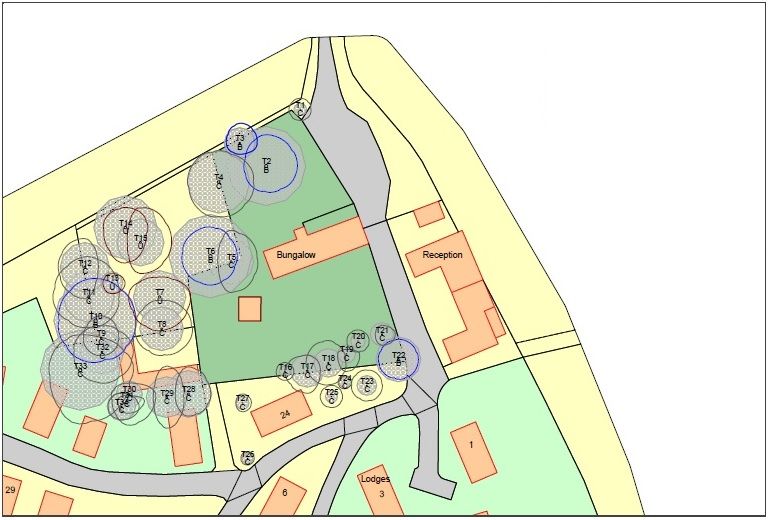
    Tree Constraints Plan (TCP)

    A CAD-based drawing showing tree location, Root Protection Areas (RPAs), canopy spreads, and shade patterns.

  • Planing survey checklist

    Arboricultural Impact Assessment (AIA)

    An evaluation of the development’s impact on the trees

  • Tree Png

    Tree Protection Plan (TPP)

    A CAD drawing showing required tree protection measures, locations of temporary tree protective fencing and Construction Exclusion Zones.

  • Graphic of a manual symbolising instructions or guidance

    Arboricultural Method Statement (AMS)

    Step-by-step guide detailing how the development will take place without causing unnecessary negative impact to the trees.
We work closely with architects, developers and planning consultants to align our reporting with your build timelines and submission deadlines.

When Do You Need a Planning Survey?

You will likely need a BS5837 survey if your site includes or is close to:
Local planning authorities will often refuse or delay applications without an appropriate arboricultural report. We ensure your application is supported by credible, professionally prepared documents.
BS tree survey consultancy and planning services graphic
Planning and tree survey services

Why Choose Us?

Get Your Planning Survey Booked

We provide planning surveys across all of Wales, the West Midlands, South West England, and beyond. Whether it’s a rear extension, housing development or commercial site, we’ll help you move forward with confidence and clarity.

Get your project off the ground with expert tree planning advice.

FAQ: Planning Surveys (BS5837)

What is a BS5837 tree survey?
A BS5837 tree survey is an arboricultural survey carried out in accordance with BS5837:2012 – Trees in Relation to Design, Demolition and Construction. It records the location, size, species, condition and quality of trees on or near a proposed development site, helping architects, developers and planning consultants understand how existing trees may influence a design. The survey forms the foundation for further planning documents such as a Tree Constraints Plan (TCP), Arboricultural Impact Assessment (AIA) and Arboricultural Method Statement (AMS). Many Local Planning Authorities require a BS5837 survey before determining planning applications where trees could be affected.
A planning tree survey is usually required whenever proposed development could impact existing trees, whether they are on your land or neighbouring land. This may include new homes, extensions, commercial developments, access roads, parking areas or changes in ground levels. Local Planning Authorities frequently request arboricultural information as part of the planning process to ensure valuable trees are properly considered before permission is granted. Obtaining a survey early can help avoid costly redesigns, planning delays and unexpected issues later in the project.
The exact documents depend on your project, but a typical planning package includes a BS5837 tree survey, Tree Constraints Plan (TCP), Arboricultural Impact Assessment (AIA) and, where required, an Arboricultural Method Statement (AMS) and Tree Protection Plan (TPP). Together, these documents explain how existing trees influence the proposed development, identify potential impacts and detail the protective measures required during construction. We tailor every package to the specific requirements of your planning application and Local Planning Authority.
A Tree Constraints Plan is a scaled drawing that illustrates how existing trees influence the development potential of a site. It identifies important factors such as Root Protection Areas (RPAs), canopy spreads, tree quality categories and future growth potential. Architects and designers use this information to position buildings, roads, driveways and services in locations that minimise conflict with retained trees. Producing a Tree Constraints Plan at the earliest design stage often leads to smoother planning applications and better long-term outcomes for both the development and the landscape.
An Arboricultural Impact Assessment evaluates how a proposed development is likely to affect existing trees throughout demolition and construction. It considers whether trees need to be removed, whether Root Protection Areas will be affected and what measures are needed to retain valuable trees safely. The report also assesses indirect impacts such as changes to soil levels, drainage, excavation and construction access. An AIA helps planners make informed decisions while ensuring trees are properly integrated into the final development wherever possible.
Yes. It’s not uncommon for planning applications to receive requests for additional arboricultural information after submission. We regularly work with homeowners, architects and developers to prepare the reports required by planning officers, respond to arboricultural queries and resolve issues that may be delaying approval. In many cases, early discussion with the design team allows practical solutions to be identified that protect important trees while still meeting the project’s objectives.
Yes. Trees protected by a Tree Preservation Order (TPO), located within a Conservation Area or forming part of an important landscape may require additional consideration during the planning process. Even where trees are not formally protected, Local Planning Authorities expect them to be assessed under BS5837 if they could be affected by development. We identify any constraints, explain the legal implications and provide the supporting arboricultural evidence required to help planning applications progress smoothly and compliantly.
Not necessarily. While some high-quality trees may influence the design or layout of a development, they do not automatically prevent planning permission from being granted. Good arboricultural design aims to retain valuable trees wherever practical while allowing development to proceed safely and sustainably. By involving an arboricultural consultant early in the design process, potential conflicts can often be resolved before a planning application is submitted, reducing delays and improving the likelihood of approval.
We work with homeowners, architects, planning consultants, developers, landowners, housing associations and Local Authorities on projects ranging from single-property extensions to larger residential and commercial developments. Our role is to provide clear, independent arboricultural advice that integrates seamlessly with the wider design team. We communicate technical findings in straightforward language while ensuring all reports meet current British Standards and planning requirements.
Black Mountains Tree Consultancy is based in Talgarth, near Brecon, and provides planning surveys throughout Powys, Monmouthshire, Herefordshire and surrounding areas across Wales, the West Midlands and South West England. We also undertake projects further afield where specialist arboricultural consultancy is required. Whether you’re preparing plans for a house extension, a new housing development or commercial construction project, we can provide the professional arboricultural reports needed to support your planning application.