If you are preparing a planning application and there are trees on or close to the site, you may need a tree survey before your proposals can be properly assessed.
Trees can influence where buildings, extensions, access routes, services and other features can be positioned. Importantly, trees do not have to stand within your property boundary to be relevant. Trees on neighbouring land or beside a highway may also need consideration if they could influence the proposed development.
A tree survey for a planning application provides objective information about existing trees and the constraints they may place on development. Getting this information early can help architects, homeowners and developers make informed design decisions rather than addressing tree-related conflicts after plans have already been prepared.
When Is a Tree Survey for a Planning Application Needed?
There is no simple rule that means every planning application automatically requires a tree survey.
The requirement usually depends on the presence of trees and whether they could be affected by, or influence, the proposed development. Local planning authority validation requirements can also vary.
A tree survey may be required where:
- Trees are present within the development site
- Trees are close to proposed buildings or extensions
- Trees on neighbouring land could influence the development
- Construction access could pass close to retained trees
- New hard surfaces or driveways are proposed near trees
- Excavation or changes in ground level could affect roots
- Underground services are proposed near trees
- Trees may need pruning or removal to facilitate development
- Protected trees could be affected
For projects involving trees, arranging a tree survey for a planning application at an early stage can provide useful information before the design becomes fixed.
What Is a Planning Tree Survey?
A planning tree survey is an arboricultural assessment undertaken to establish the characteristics, quality and constraints associated with trees on or around a proposed development site.
For development projects, tree surveys are commonly prepared with reference to BS 5837:2012, Trees in relation to design, demolition and construction – Recommendations.
The purpose is not simply to identify whether trees appear healthy. The survey provides information that can be used by the design team and local planning authority when considering how trees relate to the proposed development.
Depending on the site and project, recorded information can include:
- Tree reference number
- Species
- Height
- Stem diameter
- Crown spread
- Crown clearance
- Life stage
- Physiological and structural condition
- Estimated remaining contribution
- Tree quality and retention category
The resulting information helps establish which trees are significant constraints and how the proposed layout should respond to them.
Why Should the Tree Survey Be Completed Early?
One of the most important principles when dealing with trees and development is timing.
Ideally, the tree survey should inform the design rather than being commissioned only after the proposed layout has been finalised.
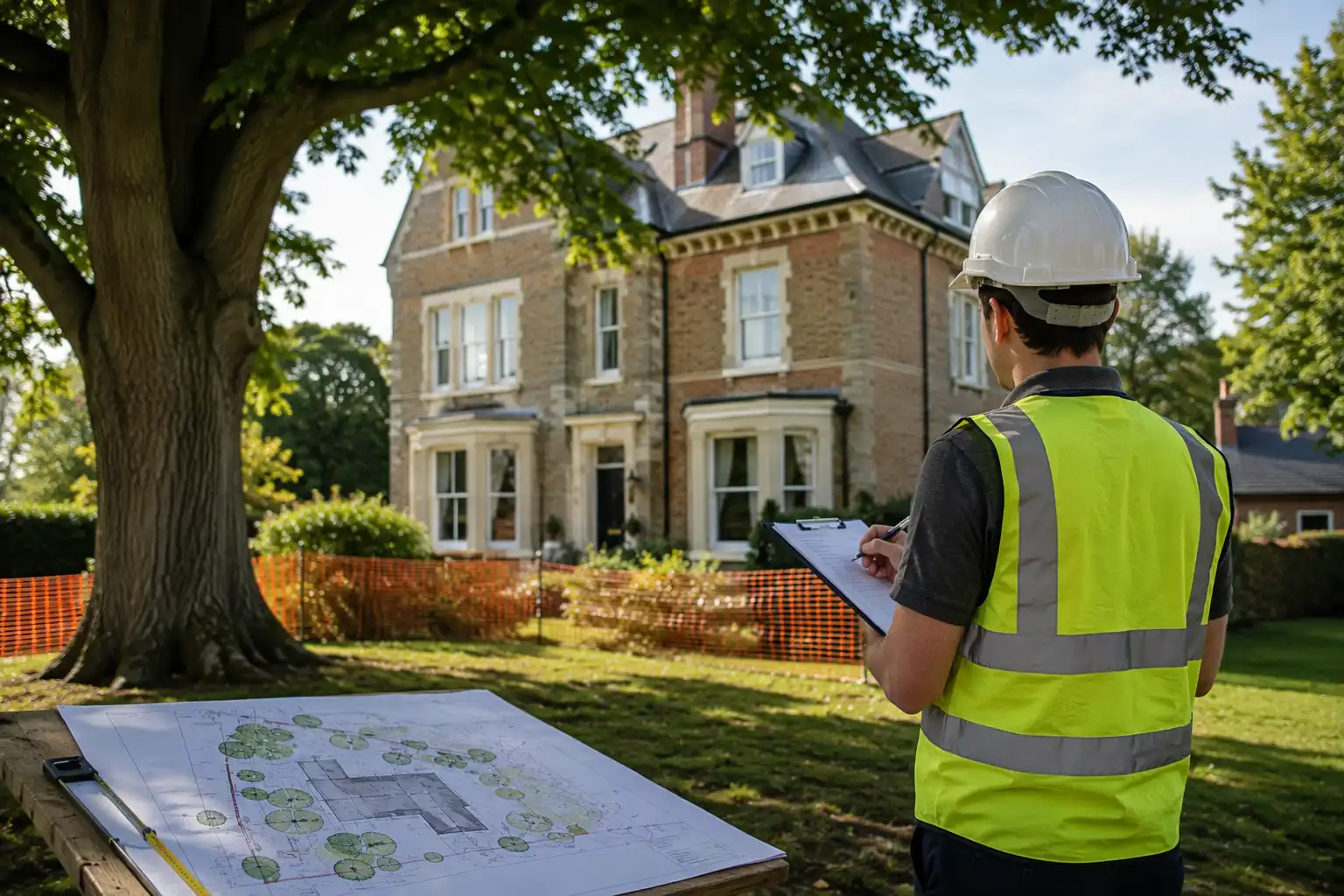
Consider a mature tree close to the position of a proposed extension. Its canopy may be clearly visible on an ordinary site plan, but its rooting area may create an additional constraint that has not been considered.
If the architect receives accurate arboricultural information early, the layout can be developed with those constraints in mind.
Early surveying can therefore help identify potential conflicts involving:
- Building footprints
- Foundations
- Driveways
- Parking areas
- Site access
- Drainage
- Underground services
- Changes in ground levels
- Construction compounds and working space
This is why early arboricultural planning support can be useful even before a planning application is ready for submission.
What Is a Root Protection Area?
A key part of understanding trees on development sites is the Root Protection Area, commonly abbreviated to RPA.
An RPA represents the minimum area around a retained tree that should normally be protected from potentially damaging development activity. It is calculated using the tree’s stem diameter in accordance with BS 5837.
Tree roots are not confined to the area directly underneath the canopy. Construction can affect roots through excavation, soil compaction, changes in levels and the installation of hard surfaces or underground services.
This means a proposal that appears to avoid a tree above ground could still create a conflict below ground.
Identifying RPAs early allows them to be considered alongside the proposed development layout.
Do Neighbouring Trees Need to Be Included?
Potentially, yes.
One common misunderstanding is that a tree survey only considers trees within the red line or ownership boundary of the development site.
Relevant trees on adjoining land may also need to be assessed where they could influence the site. A neighbouring tree may have a canopy extending towards the proposed development, while its root system may also be relevant to the layout.
The fact that you do not own a tree does not mean it can be ignored during the planning and design process.
A competent arboricultural consultant can determine which trees are relevant to the proposed development and should be included within the assessment.
Is a Tree Survey the Same as an Arboricultural Impact Assessment?
No. They are closely related, but they serve different purposes.
The tree survey records and assesses the existing trees. It establishes the baseline arboricultural information and identifies important constraints.
An Arboricultural Impact Assessment, often called an AIA, considers the relationship between those trees and the proposed development.
For example, an AIA may consider:
- Which trees are proposed for retention or removal
- Whether buildings conflict with tree crowns or RPAs
- Potential pruning requirements
- Changes to surfaces or ground levels
- Access and construction implications
- The effect of the development on retained trees
Depending on the nature and stage of the proposal, further arboricultural documents may also be necessary.
What Is a Tree Constraints Plan?
A Tree Constraints Plan helps translate the survey information into a visual format that architects and other members of the design team can use.
It typically identifies tree positions, crown spreads, retention categories and Root Protection Areas.
This can be particularly valuable during the early design stage because it allows the proposed layout to be considered against the physical constraints created by existing trees.
Rather than designing a scheme first and investigating trees afterwards, the constraints plan allows tree information to form part of the design process from the beginning.
Will I Need a Tree Protection Plan?
A Tree Protection Plan may be required where trees are being retained close to development activity.
The purpose is to show how retained trees will be protected while work takes place. Protection can be important because tree damage is not limited to cutting branches or directly severing large roots.
Heavy machinery, repeated vehicle movements, storage of materials, excavation and changes to soil levels can all affect the rooting environment.
Depending on the development, an Arboricultural Method Statement may also be required to explain how particular operations will be undertaken without causing unacceptable harm to retained trees.
The exact level of information needed depends on the site, development and local planning authority requirements.
What If a Tree Has a Tree Preservation Order?
If a tree is protected by a Tree Preservation Order, commonly known as a TPO, this is an important additional consideration.
A TPO does not necessarily mean that development cannot take place near the tree. However, its protected status needs to be properly considered when designing the proposal and determining what works may be appropriate.
There are also controls relating to trees within conservation areas.
If you are unsure whether a tree is protected or how its status could affect a development proposal, obtaining specialist Tree Preservation Order advice can help clarify the arboricultural considerations.
What Happens If I Submit Without a Tree Survey?
If arboricultural information is required but has not been provided, the planning process can become more difficult.
Depending on the local authority and circumstances, missing information may affect validation or lead to requests for additional documentation. Even where an application progresses, insufficient information about trees can make it harder to demonstrate that the development has properly considered existing arboricultural constraints.
Commissioning the correct information at the appropriate stage is therefore preferable to waiting for tree-related questions to arise later.
Before submitting an application, check the local planning authority’s current validation requirements and seek professional advice where the requirements are unclear.
Do Small Extensions Need Tree Surveys?
Sometimes.
The physical size of the development is only one factor. A relatively modest extension can still have implications for a significant tree if the proposed foundations, access or construction activity are close to its rooting area.
Conversely, a project with no trees within influencing distance may not require detailed arboricultural information.
The key question is not simply how large the development is, but whether trees could be affected by or influence the proposal.
Where this is uncertain, an initial professional tree assessment can help establish the relevant arboricultural issues.
When Should I Get Professional Arboricultural Advice?
Consider obtaining professional advice as early as possible if trees are located on or close to a proposed development site.
This is particularly important where:
- A mature or prominent tree is close to the development
- Several trees influence the available building area
- Neighbouring trees overhang or stand close to the boundary
- A TPO or conservation area may be involved
- Roots could conflict with foundations, services or access
- The local planning authority has requested arboricultural information
- You are unsure what documents should accompany the application
Black Mountains Tree Consultancy provides independent arboricultural advice backed by more than 20 years of experience. We work with homeowners, architects, landowners and developers to identify tree constraints and provide practical information for the planning process.
Plan Around Trees Before Submitting Your Application
A tree survey is not necessary for every planning application, but it can be an important requirement when trees are present on or close to a development site.
The most effective approach is usually to identify arboricultural constraints early. A properly prepared survey can help the design team understand tree quality, crown constraints and Root Protection Areas before important decisions are made.
If you are preparing a development proposal in Wales, the West Midlands, South West England or elsewhere in the UK where suitable, contact BM Tree Consultancy for independent advice on tree surveys and planning requirements.