
Separating common misconceptions from real subsidence issues
The relationship between trees and subsidence is often misunderstood. When cracks appear in a property and a large tree is growing nearby, it is easy to assume that its roots are responsible. In practice, establishing the cause of structural movement requires evidence rather than proximity alone.
Trees can contribute to subsidence under particular combinations of soil, weather, foundation and vegetation conditions. However, buildings can move for many other reasons. Understanding the difference is important before decisions are made about investigation, remedial work or tree removal.
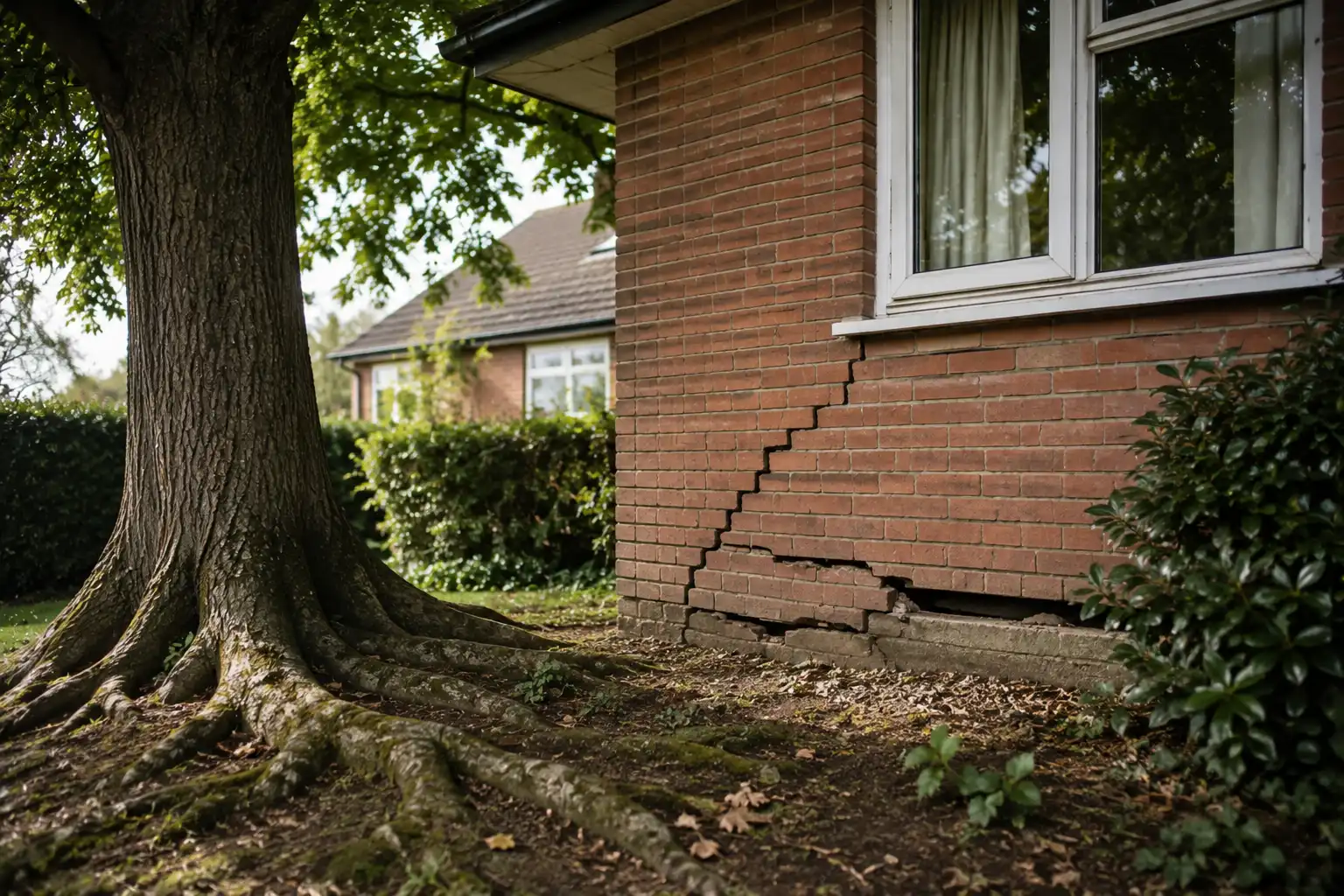
What Is Subsidence?
Subsidence occurs when the ground supporting part of a building moves downwards, potentially causing movement in the structure above. This is different from settlement, which is generally associated with the ground adjusting to the load of a building, particularly following construction.
There are numerous potential causes of ground movement. These can include changes in moisture within shrinkable soils, drainage problems, variations in ground conditions and other site-specific factors. The presence of a tree should therefore be treated as one part of the investigation rather than automatic evidence of the cause.
How Are Trees and Subsidence Connected?
Trees need water to survive. Their root systems obtain this moisture from the surrounding soil and transport it through the tree.
On some soils, particularly shrinkable clay, changes in moisture content can cause changes in soil volume. Clay can shrink as it dries and swell again when moisture returns.
Where a tree is taking moisture from shrinkable clay, this can potentially contribute to soil shrinkage.
If foundations are within the affected ground and movement is sufficient, the building may experience subsidence.
This does not mean that every tree growing near a property represents a subsidence risk.
The relationship depends on several interacting factors, including:
- Soil type and shrinkability
- Tree species
- Tree size and maturity
- Distance between the tree and building
- Foundation depth and construction
- Root distribution
- Weather and seasonal moisture conditions
- Other vegetation
- Drainage and ground conditions
- The history and pattern of building movement
A proper investigation considers these factors together.
Myth 1: Any Large Tree Near a House Will Cause Subsidence
This is one of the most common misconceptions surrounding trees and subsidence.
A large tree near a building does not automatically mean the building will experience structural movement. Many trees grow close to properties for decades without causing subsidence.
Soil is a particularly important factor. Tree-related moisture movement is primarily a concern where susceptible shrinkable soils are present.
A tree growing near a building on one type of ground may present a very different situation from the same species growing at the same distance on highly shrinkable clay.
This is why distance alone is not sufficient evidence.
Myth 2: Tree Roots Physically Push Foundations Down
Tree-related subsidence is commonly misunderstood as roots physically pushing or pulling foundations down.
Where trees contribute to subsidence on shrinkable clay, the mechanism is generally related to moisture extraction from the soil.
Roots absorb water. If that moisture loss causes susceptible clay to shrink, the ground supporting foundations may move.
This distinction matters because seeing roots close to a building does not, by itself, demonstrate that those roots have caused subsidence.
Direct physical interaction between roots and structures can occur in other circumstances. For example, roots can interact with lightweight structures, paving or walls. That is a different mechanism from clay shrinkage-related foundation subsidence.
Myth 3: Finding Tree Roots Proves the Tree Is Responsible
Roots found near a property can be relevant evidence, but their presence alone does not establish causation.
Roots naturally spread through soil in search of suitable moisture, oxygen and nutrients. Finding a root near foundations therefore tells investigators that a tree or other woody vegetation has rooted in that location, but further evidence is required.
A robust investigation may need to consider the identity of roots alongside information about soils, foundations and the pattern of structural movement.
Where appropriate, a specialist tree subsidence survey can provide arboricultural evidence to complement structural and geotechnical investigations.
Myth 4: Removing the Nearest Tree Will Solve the Problem
Tree removal should not be treated as an automatic response to suspected subsidence.
The nearest tree may not necessarily be the cause of movement. There may be several trees and shrubs within the surrounding area, or the movement may have another explanation entirely.
Removing a tree without establishing the relevant evidence can result in the loss of a valuable tree without addressing the underlying problem.
There can also be additional considerations where trees are protected by a Tree Preservation Order or situated within a conservation area.
The appropriate response should be based on the findings of the investigation rather than an assumption that the closest or largest tree must be responsible.
Myth 5: Cracks Always Mean Subsidence
Cracking can be associated with subsidence, but cracks can develop for many reasons.
Buildings experience movement over time, and cracking can be associated with materials, thermal movement, settlement, alterations, structural issues and other causes.
The location, orientation, width, progression and timing of cracks can all provide useful information to appropriately qualified professionals.
A crack should therefore be investigated in context. Its presence does not automatically establish either subsidence or tree involvement.
What Factors Increase the Risk of Tree Root Subsidence?
The potential for tree root subsidence depends on a combination of conditions rather than one single factor.
Shrinkable clay soil
Soil type is fundamental. Clay soils vary in their capacity to change volume as moisture conditions alter.
Understanding the soil beneath and around the property is therefore an important part of assessing suspected tree-related subsidence.
Where more information about ground conditions is required, professional soil analysis can help provide useful evidence.
Tree size and water demand
Different trees have different growth characteristics and water requirements. A tree’s size, age, condition and species may all be relevant when assessing its potential influence.
However, species should not be considered in isolation. The actual site conditions remain essential.
Distance from the building
Distance is relevant, but it should not be used as a simple yes-or-no test.
Root systems do not conform to a fixed circle around a tree, and rooting patterns can be influenced by soil, moisture, obstacles and surrounding site conditions.
Foundation characteristics
The depth, type and condition of foundations influence how a building responds to ground movement.
Two buildings standing near similar trees may respond differently because their foundations and ground conditions differ.
Weather conditions
Extended dry periods can reduce soil moisture. On shrinkable clay, this may increase soil shrinkage.
Trees also have seasonal patterns of water use, meaning the timing and progression of movement can provide useful evidence during an investigation.
What Evidence Is Needed to Link a Tree to Subsidence?
Establishing a credible relationship between a particular tree and building movement usually requires several strands of evidence.
Depending on the circumstances, an investigation may consider:
- The pattern and history of structural movement
- Crack monitoring information
- Foundation depth and construction
- Soil type and characteristics
- Presence and depth of roots
- Root identification where appropriate
- Tree species, dimensions and condition
- Distance between vegetation and the affected structure
- Seasonal patterns of movement
- Drainage or other potential causes
No single piece of evidence should automatically be considered conclusive.
For example, a tree being close to a crack does not prove causation. Equally, identifying roots in the ground does not establish that they have caused damaging soil movement.
The strength of an investigation comes from considering the available evidence together.
Could Something Other Than Trees Be Causing the Movement?
Yes. This is an important part of any balanced subsidence investigation.
Potential causes of movement can include problems associated with drainage, ground conditions, foundations and previous construction or alterations.
A suspected subsidence problem may also involve more than one contributing factor.
This is why an independent investigation should avoid beginning with the assumption that a tree is responsible. The evidence should lead to the conclusion, rather than the conclusion determining which evidence is considered.
Should a Tree Be Felled Because of Subsidence?
Not unless the available evidence supports an appropriate course of action.
Trees provide landscape, environmental and amenity value, and removal can be a significant and irreversible decision.
There may also be statutory protection to consider. Where a tree is implicated in a subsidence investigation, the appropriate management response depends on the circumstances and the evidence available.
In some cases, further monitoring or investigation may be required before a reliable conclusion can be reached. An independent professional tree assessment can help establish the tree’s species, dimensions, condition and other arboricultural characteristics relevant to the investigation.
Can Pruning Prevent Tree-Related Subsidence?
Pruning should not be assumed to provide a straightforward solution to tree-related subsidence.
The relationship between pruning, tree water use and soil moisture is more complex than simply reducing the size of the crown. Trees can also respond to pruning by producing new growth.
Any proposed management should therefore be based on the characteristics of the individual tree, site conditions and the evidence from the wider subsidence investigation.
Tree management decisions should not substitute for determining the underlying cause of building movement.
When Is Professional Advice Needed?
Professional advice is particularly valuable where structural movement has been identified and trees are being considered as a possible contributing factor.
A subsidence investigation can involve several professional disciplines. Structural, geotechnical, drainage and arboricultural evidence may all be relevant depending on the circumstances.
An arboricultural consultant can assess the trees and provide independent information about their species, dimensions, condition and relationship with the affected property.
BM Tree Consultancy provides independent arboricultural advice with more than 20 years of experience. Our tree subsidence surveys help homeowners, landowners and property professionals investigate the role that trees may play in suspected subsidence.
Evidence Should Come Before Tree Removal
The key point when considering trees and subsidence is that proximity does not equal causation.
Trees can contribute to structural movement where suitable conditions exist, particularly where moisture extraction affects shrinkable clay beneath foundations. However, the presence of a nearby tree is only one element of a much wider investigation.
Good decisions depend on evidence. Soil conditions, foundations, roots, tree characteristics, seasonal movement and alternative causes should all be considered before responsibility is attributed to a particular tree.
If you need independent arboricultural input into a suspected tree-related subsidence problem, contact BM Tree Consultancy for practical advice and specialist assessment.